 Prana Nidra
Home · What is prana nidra
The practiceWhat is prana nidra
Prana nidra is a practice of conscious rest that works with prana, the vital energy, through the exhalation and the attention. You do it lying on your back, it takes between seven and twenty-one minutes, and it needs no prior experience and no one to guide you. Andrei Ram received it from his teacher, Sri Dharma Mittra, and arranged it into four stages.
What prana nidra means
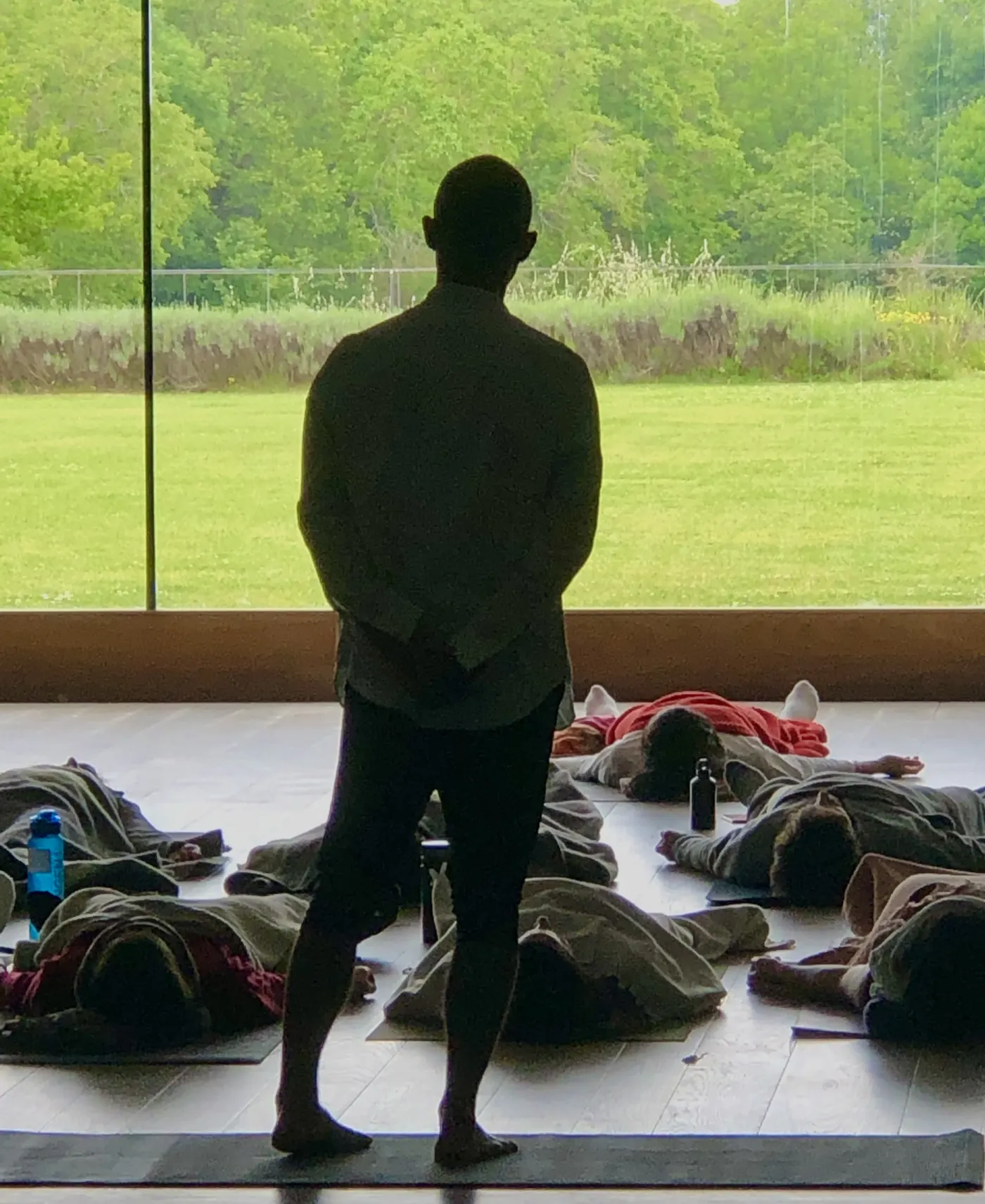
Prana is the vital energy and nidra means both sleep and sleeping; together they name a rest you take while awake. The book defines it as a form of conscious rest through prana, or vital energy, and explains that it uses simple breathing and visualization exercises to clear, relax, and harmonize the energy body. There are no postures and no effort. There is a person lying down, eyes closed, who exhales and moves the attention through three points of the body. From the outside it looks like a nap. From the inside, as Andrei puts it, nidra is concentrated rest.
The three points are the solar plexus, the lunar plexus, and the spiritual heart. The first sits below the ribs; the book calls it our inner sun and the ruler of prana nidra. The second, between the eyebrows, gives precision and clarity. The third, in the center of the chest, is where the resting happens. Andrei sums them up as the source, the amplifier, and the harmonizer. The practice is to inhale from one, hold for a couple of seconds, and exhale toward another, following a fixed route. Nobody imagines these points; the book says you use consciousness to amplify what they already do. That is why the body rests while the mind gets clearer, not duller.
Prana nidra, yoga nidra, and NSDR: how they differ
All three are done lying down with the eyes closed, and all three look for deep rest without falling asleep; they differ in what they work with, how long they take, and who guides them. Yoga nidra, as Andrei distinguishes it, asks for at least 45 minutes and the guidance of an experienced person, and it travels through the whole body layer by layer. Prana nidra takes 7 to 21 minutes, works with the first three koshas, the physical, energetic, and mental layers, and, in the book's words, can be done alone. NSDR, non-sleep deep rest, is the name neuroscientist Andrew Huberman gave to guided relaxation protocols inspired by yoga nidra, meant to restore attention in 10 or 20 minutes.
| Prana nidra | Yoga nidra | NSDR | |
|---|---|---|---|
| What it works with | Prana: exhalation and attention moving between three centers | Rotation of consciousness through the whole body, sensations, visualization | Guided relaxation of the body and the breath |
| Length | 7 to 21 minutes | 45 minutes or more, as Andrei teaches it; some schools offer 20-minute versions | 10 to 30 minutes |
| Guidance | Can be done alone once you know the sequence | An experienced person guiding | A guided audio or video |
| Where it comes from | The lineage of Yogi Gupta and Sri Dharma Mittra; Andrei arranged the sequence | Tantric texts; modern form codified in the 1960s and 70s | Term coined by Andrew Huberman in 2020 |
| What for | Getting your vitality back in a pause during the day | Deep relaxation and long inner work | Resting and recovering attention |
A lineage and a sequence
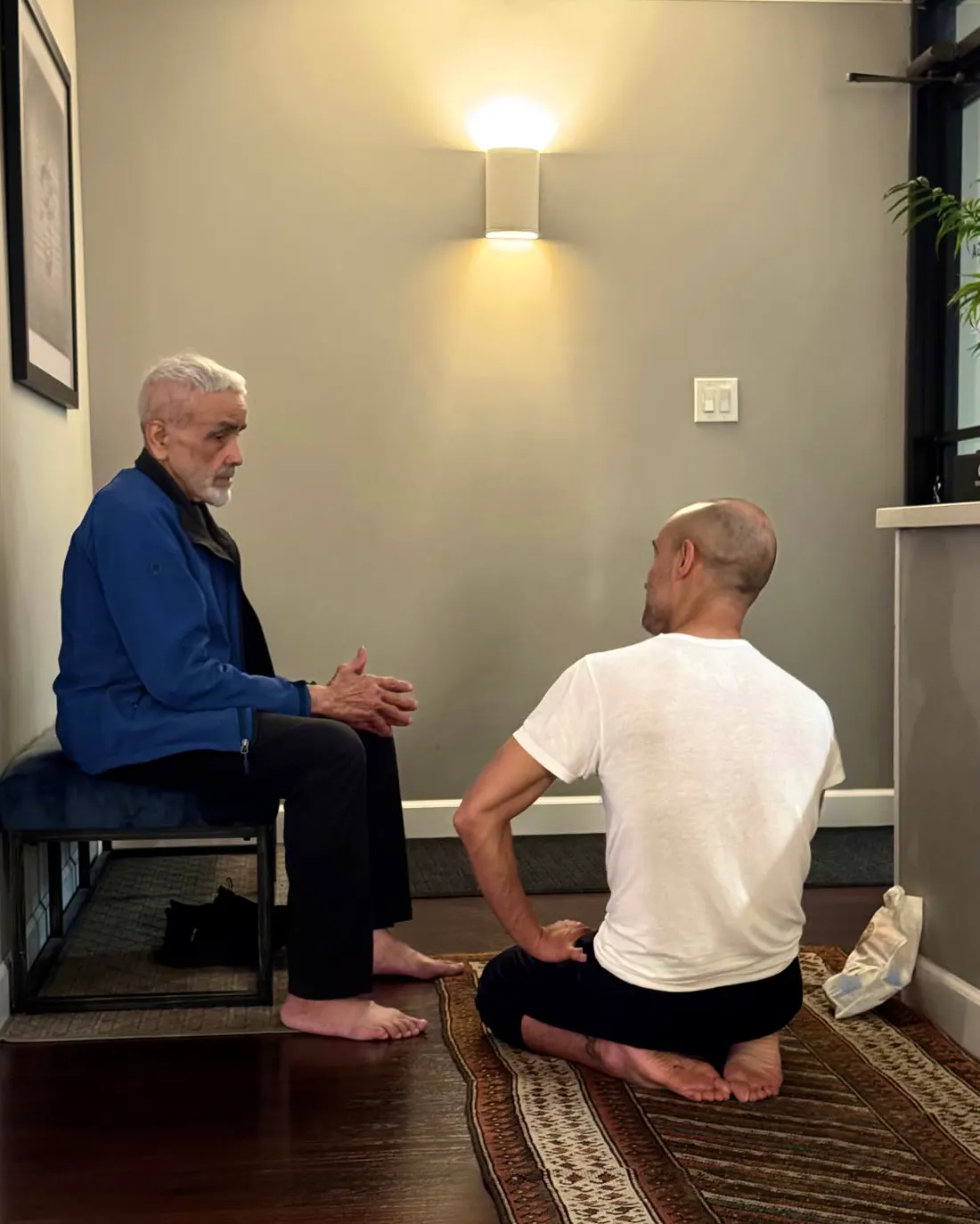
Andrei Ram first met prana nidra in 2002, in one of the first classes he took from Sri Dharma Mittra at his temple on Third Avenue in Manhattan. Dharma had received it in turn from his guru, Yogi Gupta. What Dharma taught came in loose pieces, between one posture and the next, and without a name. The book tells it plainly: Dharma never called it that, and never taught its stages in order. Andrei spent eleven years at his side, two as a renunciate and nine as part of his team, and in that time he gathered the pieces into a sequence.
That is why Andrei does not say he created the practice. He writes that he wasn't inventing anything, only organizing what he had received from his teacher, and his teacher from his own; the others at the temple called him the translator. That sequence, with its four stages and its three centers, is the one he has taught since then in trainings and retreats across the Americas, Europe, and Asia, and the one captured in the book he wrote with journalist Jorge Caraballo Cordovez. Who Andrei Ram is and where he teaches, on his page.
The four stages of a practice
A prana nidra practice moves through four moments, draining, rest, recharge, and close, driven by two forces that cost no effort: gravity and the exhalation. The book gives them a chapter of their own and, later on, the full script of each one with its timing and its breaths. Here is what each stage does, not the script.
- Draining. You inhale from the solar plexus up to the point between the eyebrows, hold for a couple of seconds, and exhale fully toward a different limb each time, in a spiral that turns counterclockwise. The aim, in the book's words, is for energy to flow and for the residue that blocks it to leave.
- Rest. The attention settles in the spiritual heart and does nothing else. It is the stage of total rest and can last anywhere from one to fifteen minutes, whatever each person decides. It is the stage where many people fall asleep.
- Recharge. The spiral turns the other way. In the draining you exhale out through the fingertips; in the recharge you exhale as far as the fingertips, so the energy stays and revitalizes. This cycle is done once.
- Close. Three breaths that come in and go out from the solar plexus alone, with a short intention the book proposes along these lines: I identify with vitality and carry it wherever it's needed. Then you open your eyes and get up slowly.
The exact route of the spiral, the holds, and the five variations of the practice are in the book Prana Nidra and in the audios guided by Andrei.
How long it takes, where to do it, and when
A practice takes between seven and twenty-one minutes, is done on the floor lying on your back, and pays off more during the day than at night. The length depends on how long each person chooses to stay in the rest stage; Andrei recommends setting an alarm for the end. The floor matters: a mattress throws off the alignment and doesn't spread the body's weight the same way, so the book asks for a mat or a blanket, and answers anyone who insists on the bed with a simple: do it, better that than nothing. Silence and darkness help, but they aren't essential; headphones also work as a signal that you don't want to be interrupted.
The time of day is where prana nidra parts ways with most of what you read about yoga nidra. It is not a before-bed practice. Andrei places it in the daytime, where it is especially valuable in the energy dips, around two or three in the afternoon or after a large meal, leaving at least fifteen or twenty minutes after eating. At night, if you use it to fall asleep, you do only the draining stage and never the recharge, which wakes you up. And if you fall asleep halfway through, the book settles it: nothing is wrong with falling asleep, it isn't a failure, and if it happens, let it, because it's rest all the same. It is the doubt that comes up most among people who practice: in the 44 Spanish-language comments about yoga nidra we read in forums, blogs, and reviews, 34 described a doubt or an experience, and 8 of those people had fallen asleep and didn't know whether they had done it right.
What prana nidra is not
Prana nidra does not replace sleep. The book warns about it on its first page and comes back to it later: many people, by cutting hours of sleep, have done themselves physical and psychological harm. Its purpose is to improve the quality of your rest, not to stand in for the hours in bed. That's worth keeping clear, because unsourced claims circulate along the lines of "one hour of nidra equals four hours of sleep," and Andrei says the opposite.
- 1Nor is it a treatment. The healing practices, the book writes, do not replace treatments suggested by therapists or doctors.
- 2Nor is it meditation, even though it prepares you for it. Andrei calls it an excellent prelude to meditation: it complements it and makes it more accessible.
- 3Nor is it a nap. In a nap, consciousness switches off; in prana nidra the body rests while the attention stays awake and at work.
- 4Nor is it yoga nidra. They share the posture and the rest, but prana nidra is shorter, works with prana, and needs no outside guide.
- 5Nor is it a fix for everything. It doesn't claim to be a magic solution to all that weighs on us, Andrei writes. It takes practice, and Andrei himself asks for skepticism.
Listen first, then understand.
The shortest way to know what prana nidra is, is to do one. On this site you can listen to the full basic practice guided by Andrei, seventeen minutes lying down, and read the first 26 pages of the book; all we ask is your name and email. The book then explains the why of each step, chapter by chapter, and the audios bring you the five practices in Andrei's voice.
The questions people ask when starting
The questions people ask when starting (what if you fall asleep, can you do it in bed, are there contraindications, how often) are in the FAQ.
Text by Andrei Ram with Jorge Caraballo Cordovez, drawn from the book Prana Nidra: The Art of Conscious Rest (2026). Last reviewed: October 8, 2026.